
Overview
Treasury Software's Bank Rec Online includes powerful automated matching tools that help reconcile bank transactions against your General Ledger quickly and accurately.
Most users achieve excellent results by first running the system's predefined matching rules and then refining the process with optional Categories and User Defined Matching Rules as needed.
This guide explains:
- How Automated Matching works
- How to run your first matching session
- Predefined One-to-One Matching Rules
- Many-to-Many Matching Rules
- Categories and User Defined Rules
- Best Practices and FAQs
Table of Contents
- Automated Matching Overview
- Running Your First Match
- Predefined One-to-One Matching Rules
- User Defined Matching Rules
- Categories
- Frequently Asked Questions (FAQs)
Automated Matching Overview
After importing your bank transactions and General Ledger records, Bank Rec Online automatically analyzes both sets of data and attempts to create matches based on predefined matching logic.
Recommended Approach
For new reconciliations, Treasury Software recommends:
- Import Bank Records
- Import G/L Records
- Run Automated System Matching
- Review matched transactions
- Review unmatched transactions
- Add Categories or User Define Rules if needed
This approach provides the fastest path to a highly accurate reconciliation.
Running Your First Match
How Do I Run Automated Matching?
After importing records:
- Open the Matching Window
- If new records were imported, Bank Rec Online automatically starts the matching process
- Allow the process to complete before navigating away from Bank Rec
Important
Do not switch to another screen while Automated Matching is processing.
Once complete, you'll see:
- Unmatched Bank Records on the left
- Unmatched G/L Records on the right
From this screen, you can also manually match transactions when necessary.
For additional details, see the Matching Window Help Guide.
Predefined One-to-One Matching Rules
One-to-One Matching compares a single bank transaction against a single G/L transaction.
Bank Rec Online includes several built-in matching rules.
Available One-to-One Rules
Check to Check - matches transactions based on check numbers
Void to Issue - matches voided transactions to original issued transactions
Alphanumeric Matching - matches records using reference text and identifiers
How Rules Run
- Rules are processed from top to bottom
- You can enable or disable individual rules
- User Defined Rules are initially disabled until configured
For additional details, see One-to-One Matching Help Guide
Many-to-Many Matching Rules
Many-to-Many Matching is designed for situations where multiple transactions on one side correspond to one or more transactions on the other side.
Common examples include:
- Deposits grouped by the bank
- Batch transactions
- Summarized accounting entries
- Merchant service deposits
How Many-to-Many Matching Works
The system follows a two-step process:
Now the fun part - high speed matching.
We typically recommend that you initially run the Automated System Matching using the predefined default rules.
After running the Automated System Matching, you can review the results and turn on/off the predefined rules - as well as customize your own using 'Categories'
I just imported my records. How do I run Automated System Matching?
Click on the Matching Window and this will trigger the system matching to run if you've imported records since the last time you entered the Matching Window.
Note: Once started, do not switch out of Bank Rec until the matching process completes.
When finished matching, the Matching Window will display the unmatched:
--Bank Records on the left, and
--G/L Records on the right.
Spoiler alert: You can click to select records and then match them here (see below).
For details on this page, see the Matching Window Help page.
Matching Window
Review the Matching Window for any records that you would like to set up a rule for.
In addition, run the Matched Only report (Reports tab > Matched Only) for any records that should not have matched.
I. Predefined Matching Rules
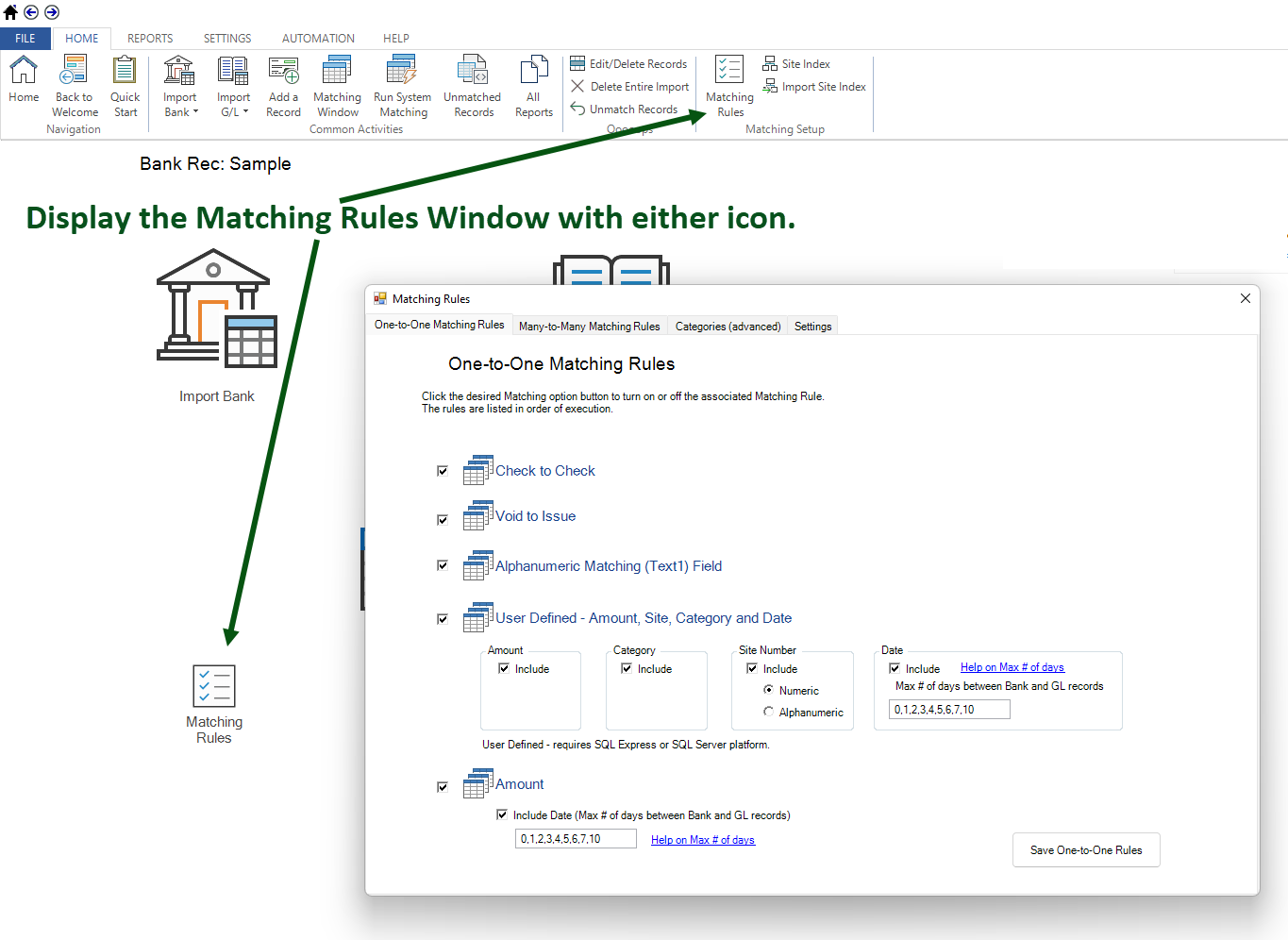
One to One Matching Rules
The system comes with predefined high speed matching rules:
- Check to Check
- Void to Issue
- Alphanumeric Matching
- Amount
Check the rules you want turn on.
Rules are run in order from top to bottom.
Note: We have User Defined turned off for now as this requires further setup (not a predefined rule).
For details on this page, see the One to One Help page.
Many to Many (and One to Many) Matching Rules
All Many to Many (and One to Many) rules work in the same two step process:
1. Groups transactions based on the matching rule being used into summarized records.
2. Attempts to match the summarized records
The system comes with predefined high speed many to many rules:
- Alphanumeric Matching (Text1)
- Date and Category
- Check Number
Check the rules you want to turn on.
These rules are run after the one to one matching rules.
When we refer to many to many matching, we are also referring to one (Bank) to many (G/L) rules.
Many to Many Matching - Matching Field
For details on this page, see the Many to Many Help page.
End of Predefined rules.
II. User Defined Matching Rules
User Defined Matching Rules are a feature of the Corporate and Advanced edition and is not required to be used.
We recommend that you first run Bank Rec with just the predefined rules, and then review as to what User Defined Rules / Categories are needed, if any.
Categories
The goal of 'Categories' is to increase the accuracy of the matching process by assigning an additional attribute to each record, which can then be used in the matching process.
For example, in a depository account, we might have two transactions, each for $220.
One might be a credit card deposit, the other a check deposit.
To make sure that we don't accidentally cross-match the transactions, we add a 'Category' attribute to each of these records.
In this example, the bank side may show 'Credit Card Des' for Visa/MasterCard transactions, but the G/L side will show 'MC/V'. By identifying each text string as the same Category, the two data items can be matched automatically by the system.
Example: Set your rules in the Bank and G/L tabs of the Category Page in a 'Point and Click' process.
No programming required.
Sample Bank Rules
For details on this page, see the Categories Help page.
Tips:
Triggering System Matching
Typically, you do not need to trigger System Matching.
Bank Rec will automatically run system matching when you enter into the Manual Matching Window for the first time since adding/importing records.
You can manually trigger System Matching if you updated records, and it would be appropriate after updating the Category Rules.
Unmatch Records if needed
To unmatch records, run an All Records (or similar) report.
Select the records to unmatch and click on the Unmatch icon.
For details on Reviewing, Unmatching and Rerunning the system matching, see the 'Reviewing, Unmatching and Rerunning' Help page.
We recommend that you review the Matching Rules pages in this Help chapter.